Methods, tools, and training developed by us, based on ongoing research and 8 years of hands-on experience in employee advocacy.
Employee advocacy programs that grow organizations
17 employees.
1.2 million people reached.
Six months.
That’s not a marketing headline. It’s one of our case studies. When employee advocacy works – genuinely, with the right people posting the right content consistently – it outperforms most other channels organizations spend money on.
We’ve built 40+ such programs over eight years. Trained 1,200+ advocates. Published 9 pieces of original research on what actually makes these programs succeed – and where most of them quietly fail. And here are the clients we helped to build their employee advocacy programs:






Our employee advocacy services
Programs and strategy
We create employee advocacy programs designed to ensure return on investment, project success and continuity, ambassador engagement, guideline development, motivational systems, different ambassador groups, and clear program rules.
Training
Our continuously updated training program empowers employees to create content, overcome fears, understand how platforms work, discover their authenticity, and master content creation and strategy. The training is based on real practice and real examples.
Workshops
Theory gives knowledge; practice helps people believe they can do it. During workshops, we help ambassadors define their positioning, goals, audiences, content plans, and action plans. Our own exercises and methods help participants see their potential.
Mentorship
Management of the ambassador team throughout a 6–12 month project. We organize monthly meetings, additional training, ongoing support with content review and idea generation, coordination of the internal communication group, 1:1 conversations, and report preparation.
Audits
We analyze the current state of employee advocacy in your organization, help identify its potential, assess possible results, and design the right advocacy process for your organization.
We develop employees and leaders to share meaningful, value-creating stories — not simply add more noise to social media.
1200+
ADVOCATES MENTORED
40+
EMPLOYEE ADVOCACY PROGRAMS
120+
TRAINED ORGANIZATIONS
150+
ADVOCACY AUDITS
9
EMPLOYEE ADVOCACY REPORTS
2018 M.
FIRST CREATED EMPLOYEE ADVOCACY PROGRAM
Employee advocacy that works
Our 2025 research analysed 106,000 employee LinkedIn accounts across 1,800 Lithuanian companies. What we found was outstanding:
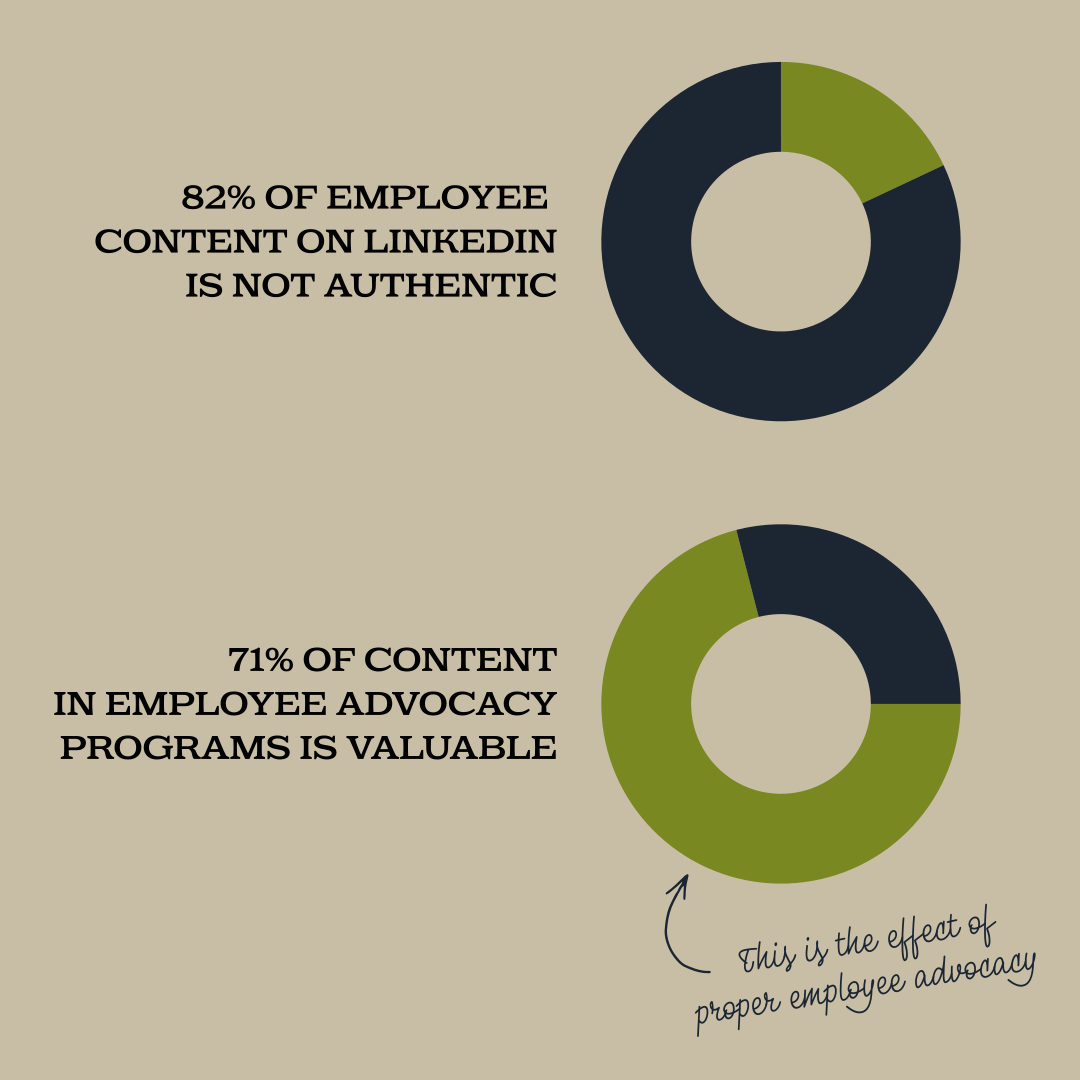
82% of employee content on LinkedIn is not authentic – it’s reshared corporate posts, generic announcements, or content without value to the reader.
Only 18% qualifies as original, value-creating communication.
But that changes, when organizations start employee advocacy programs, driven towards thought leadership and authentic content. Our benchmark of content created by employees in organizations with employee advocacy vs without, showed:
71.1% of employees at companies with proper advocacy programs produce value-creating original content: expertise, reflections, culture, authenticity.
Why and when this happens?
There is growing pressure for professionals to build their personal brand and be visible on platforms like LinkedIn.
But visibility without clarity often leads to content that feels generic, uncomfortable, or artificial.
Many people start with good intentions, but without the right strategy, confidence, or guidance, they struggle to find their voice.
With the right training, structure, and support, this changes.
When people understand their goals, learn how to work through their fears, identify meaningful topics, and recognize the value of their own experience, they begin to create communication that feels natural, authentic, and valuable — both for themselves and for their audience.
The gap between 71% and 18% is where strategic employee advocacy live.
Everything we build is designed to move your organisation into that first group.
How we create value for our clients?
Focus on organizational results and ROI
We not only help create programs that attract employees or potential clients, but also help develop methods for measuring return on investment.
A holistic approach
We know that LinkedIn or Facebook training alone will not encourage employees to share their stories or deliver the results an organization is looking for. That is why our method includes strategy and program development, in-depth training and workshops, as well as 6–12 months of mentorship.
Methods born from real practice
We created our first employee advocacy program in 2018, and since then, we have rebuilt and updated our programs every year. We respond to changes in social media behavior, employees’ attitudes toward communication, and use these insights to shape our methods.
Evidence-based decisions
We aim to grow not only our clients, but the entire market. That is why several times a year we conduct various studies on employee advocacy. Based on the results and ongoing changes, we adapt our programs accordingly.
Flexibility
When creating employee advocacy programs, we first listen to the client’s needs, goals, employee profiles, and organizational specifics. A solution that works for a manufacturing company will not necessarily work for a B2B service organization, so we always look for the most suitable approach for each client.
Developing authenticity
As employee advocacy becomes more popular, the expectation to create authentic and valuable content is also growing — not just posts about cake days. That is why we help employees discover their topics, overcome fears, understand the value of personal branding, and raise the overall quality of their content.
The methodology behind our work
These are not industry frameworks we repackaged. They’re methods we developed ourselves – through 120+ companies consulted & trained on employee advocacy, 40+ full programs created, 150+ audits, and annual research across thousands of organisations. We don’t publish them in full. We apply them, together with your team, when we work together.
Some of frameworks we created and use:
Advocacy maturity model
A five-stage model of how advocacy programs actually evolve – from first attempts to self-sustaining ecosystems. We use it to place your organisation honestly on the curve and design realistic support for the stage you're in.
Advocate archetypes design
A library of 18 distinct advocate profiles across four categories – built from mentoring 1,200+ real advocates. Used to set realistic goals per person, assign suitable content formats, and design motivation systems that fit who people actually are.
Three-group activation model
Not every employee should be an advocate. We segment employees into three groups – accelerators, spontaneous creators, and advocates – each activated differently and each contributing to program success in their own role.
Authenticity migration method
A structured approach to moving advocate content from surface-level corporate posts toward genuine, value-creating communication. This is where the 82%-to-18% gap closes. Includes positioning exercises, content frameworks, and fear-addressing methods.
Authentic stories game
A multi-part workshop designed to help advocates recognize story patterns in their everyday experience and unlock the potential of their storytelling. Through discussion, story mapping, and role-play, participants discover that they have far more valuable stories to share than they often realize.
ROI measurement system
Most programs can't prove their value – so they quietly lose budget. We've built a measurement model that translates advocacy activity into reach-equivalent ad spend, CV quality, page traffic, and other concrete business metrics the C-suite understands.
What our clients say about working with us
We only managed to implement the ambassador program in our company on the third attempt, and I believe its success was shaped both by Deividas’ top-level expertise in this field and by his personality.
What I value most about Deividas is his flexibility – there is never one scenario that fits every organization, and sometimes you need to improvise – as well as his ability to respond to real pain points, especially in those moments when you feel like giving up and colleagues stop posting. He also brings a strong analytical side and has the ability to explain things in a simple, down-to-earth way.
Deividas developed a tailored corporate advocacy framework for us, specifically designed to meet the needs of an international food retail company. He also took into account the diverse cultural backgrounds and varying levels of experience with corporate influencer programs across our organization.
What stood out most was Deividas's exceptional sensitivity in dealing with our complex, company-wide topics. He showed us the different perspectives and helped developing solutions that we can use in our daily work.
From the very beginning, Deividas showed a deep understanding of our needs. His expertise in social media and personal branding became a real turning point for our team.
What sets Deividas apart is his flexibility and client-oriented approach. He is always ready to adapt to our specific needs and offer tailored solutions that perfectly match our goals. His contribution significantly strengthened our program.
When we invited Deividas, our goal was to make LinkedIn feel more familiar and natural within the City Service group of companies.
Thank you, Deividas, for making the collaboration feel so effortless. Thank you for your professionalism and for leading the team with positivity toward measurable results and personal discoveries throughout the project.
The most valuable part is that even after the joint project has ended, continuity remains: communication on LinkedIn has become a natural part of our organization.
Working with Deividas is both easy and rewarding.
What stands out most is his competence and ability to connect with people. He communicates in a simple, genuine way, making it easy for employees to engage, learn, and feel comfortable asking any kind of questions. He not only shares knowledge but also motivates and encourages along the way.
Deividas is responsible, creative, and truly invested in delivering quality. You can count on him to keep things on track, bring fresh ideas, and adapt when needed.

When initiating an ambassador program, it is very important to define a clear strategic direction. Deividas guided us through this part very well, asking the right questions and steering us in the right direction.
What we appreciated most when working with Deividas was his involvement in the team’s day-to-day realities. The greatest compliment came from the ambassadors themselves, who would say that it felt like he knew everything, was fully aligned, and could suggest a topic or angle as if he were part of our everyday work.
And, of course, his proactivity. It is a pleasure to work with partners who truly care.
Deividas’ employee advocacy training for both managers and employees was one of the best decisions. He shares his experience in a sincere, open, and engaging way – what makes it especially valuable is that he has gone through this journey himself from the very beginning and clearly understands what works and what doesn’t.
Deividas has extensive experience working with various organizations and brings a wealth of real, practical examples.